
Service continuity
Redundant, isolatable runs and leak-tight joints keep critical building services online.
Industries / Hospitals
Closed-loop and utility distribution for buildings that cannot schedule downtime and cannot compromise on cleanable internal surfaces.
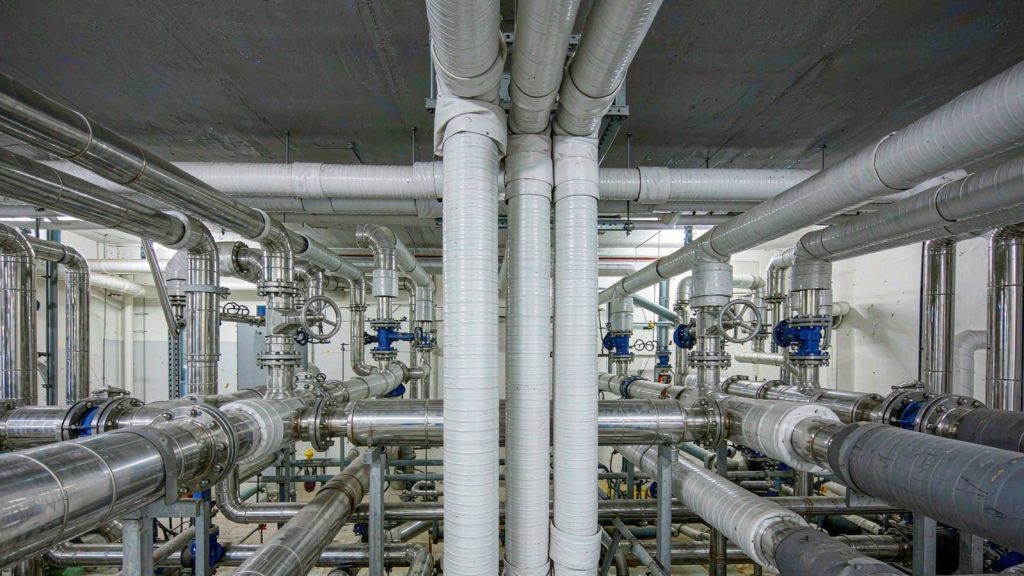
Application requirements
The pipework is specified by the failure modes it has to prevent, not by a catalogue part number.
Redundant, isolatable runs and leak-tight joints keep critical building services online.
Smooth bore, full-penetration joints and passivated surfaces limit biofilm and sediment traps.
Press-fit and prefabricated assemblies reduce hot work in occupied buildings.
Composition and mechanical values documented per batch with Mill Test Certificates.
Where our piping fits
Complete loops are engineered to your P&ID or CAD package; these are the building blocks we fabricate in-house.
Elbows, tees, reducers and flanges for fast, flameless assembly.
Plant-room and riser runs built off-site to installation drawings.
Custom port-count manifolds for plant-room isolation and balancing.
Typical configuration
The table below describes the parameters we normally agree at engineering review. Nothing here is a fixed catalogue SKU - final values follow your drawing, coolant and acceptance criteria.
NSF / WRAS material standards and DVGW W534 press-fitting tests are component-level standards. Yijia Pipe does not claim medical-device or healthcare-system certification.
| Material | AISI 304 / 316L seamless stainless tube |
|---|---|
| Size range | DN15 - DN100 fittings in V and M press profiles |
| Verification | Hydraulic pressure test; 100% helium leak test on custom liquid cooling assemblies |
| Documentation | EN 10204 3.1 MTC, dimensional inspection record |
Delivery
One engineering team owns the loop from manufacturability review through to the leak-test record.
Sector notes
Technical articles for this sector. New notes appear here automatically as they are published.
Technical notes for this sector are being prepared. In the meantime, send your drawing or P&ID and our engineers will reply with manufacturability feedback.
Ask an engineer →FAQ
Short answers grounded in what we actually fabricate and test.
Joint method, internal surface finish and cleanability drive the specification. We use orbital-welded or press-fit stainless joints, then passivate and cap the interfaces before packing.
Material batches are supplied with EN 10204 3.1 mill test certificates. A certificate describes the material batch; assembly verification is a separate dimensional, pressure and leak-test record.
Yes. Retrofit work starts with what cannot change: existing connection types, available access and the isolation arrangement. We capture those constraints in a scoping checklist before discussing new fabrication.
Related
Every industry page links back to the hub and to the other four sectors.
Next step
Send the drawing or a component list. Our engineers reply with manufacturability feedback, an indicative lead time and a quote.